Monday, January 9, 2012

Ushuaia - Part 2

December 22, 2011

USHUAIA, ARGENTINA -- Greetings once again from the Hotel Ushuaia, Tierra del Fuego, Argentina.

This morning we got up and had one last breakfast on-board the M/S Expedition. We said goodbye to our staff and crew, and officially disembarked at 8:00am. We dropped our luggage off in town, and then spent the morning on the main drag of Ushuaia in a coffeehouse, and then later looking for Antarctica souvenirs.

While looking for Antarctica souvenirs, I realized that, to my huge surprise, there were virtually zero acceptable ones. Given that 95%+ of all travelers to Antarctica embark and disembark out of Ushuaia, I figured with near certainty that there would be some ability to buy souvenirs in Ushuaia after the trip, but quickly I summed three major flaws with the Antarctic souvenirs:

1) Political. Many of the souvenirs in Antarctica refer exclusively to Argentine Antarctica, referring to the universally ignored claim to a significant portion of the land by Argentina. All maps have Argentine Antarctica shaded in a different color and emphasized in some way. It's total bogus, but so the souvenirs said.

2) Language. While I am perfectly fine with a number of the souvenirs being in Spanish, given we were are in a Spanish-speaking country, it is ridiculous that you can't find a simple sweatshirt, or a keychain, or a magnet that doesn't say "Antartida." Remember those 95% of travelers to Antarctica who go through Ushuaia? I'd bet a lot that says over half of them speak English, and probably far more than that. But nope, no Antarctica sweatshirts, only Antartida.

3) Biological. Okay, so I can't find a magnet that doesn't contain a crummy politically-influenced map or Spanish, but surely there are magnets just of penguins, right? Well, that would be correct, but having spent the past week and a half studying and quickly identifying the various different species of penguins, it is incredibly clear that almost all souvenirs are photos or drawings of Emperor Penguins. That is all fine and dandy, except for one problem: virtually nobody gets to see them. If you read the blog updates, you'll know we spent the vast majority of our time around Gentoo and Chinstrap Penguins. We saw a Macaroni and Adelie Penguin, as well as a Magellanic Penguin colony too. That said, Emperor Penguins live much further south, and worse, they are inland. You need a ton of luck with ice conditions and then a helicopter excursion to get there, which is possible, but highly unlikely for the average tourist in Ushuaia. I am sure most people don't care so much, but I wasn't going to buy an overpriced magnet with a penguin on it that I never came remotely close to seeing.

So, entrepreneurs, if you are looking for an easy market to enter, I highly encourage you to create souvenirs to sell in Ushuaia that avoid the three problems noted above. They are all pretty weak, and you are sure to do well if you just take a logical approach to it. In a half-day searching, I managed to find one glass-etched penguin that was a Gentoo. That is it.

From our relatively unsuccessful souvenir shopping we hiked it back up to the Hotel Ushuaia, which has a fabulous view of the Beagle Channel, and we knew they had decent food and good, free internet. We all are finally online, with some more substantial status updates to share our experiences with the world. From here, we are off to the airport, and tonight fly up to Buenos Aires, for our first night of total darkness in about two weeks.

Drake Lake

December 21, 2011

USHUAIA, ARGENTINA -- Well, we have made it back safely to Ushuaia! We made phenomenal timing due to a really smooth crossing of the Drake. Last time, going south, we had about 20 foot swells… these were less than half that, at max, and overall it wasn’t a big deal. The only people who got remotely sick were those who were taking sea-sickness medication, and it was the medicine that made them feel unwell.

Due to “Drake Lake,” we were able to maintain a higher speed, and despite our scheduled arrival being 8:00am tomorrow, we pulled into the Beagle Channel around 2:30pm today, and we were tied to the dock by 7:30pm, a few hours ago.

A few highlights from today...

We woke up this morning at the early hour of 6:15am, so that we could get on the ship intercom as per our Save the Albatross auction victory from last night. We woke everyone up around 6:30am, which was actually our usual wake-up time while in Antarctica, but we told everyone it was 7:30am. Seeing as there are no clocks in the rooms, and nobody was on a working phone, everyone bought it. Watching their reactions when they found out it was actually an hour earlier was priceless. Last night, when we won this, we were told that the last cruise did a 15-minute rendition, so that was our target. In order to make it that long, we thought it would be both annoying and clever to thank every single crew member by name, so we painstakingly thanked them, mostly in some sort of comedic way. We made reference to Matt's desire to be reincarnated as an elephant seal, Kevin's love of birds, Scott's disdain for Scott, etc. Then, at the end, we told everyone we had a sighting of blue whales from the ship, and to get out on deck to see them. To give it some authenticity, at the end, we translated the last bit into Spanish, which was normal procedure for ship announcements (almost all announcements were translated into Spanish for a large contingent of Spanish-speakers on the expedition). To see the announcement, spoken and enunciated slowly and clearly, as per our expedition leader Susan, go ahead and click here.

After the announcement a few of us hung around for a bit, and there were a couple dozen people who came out to get coffee and tea, all of whom were shocked to see the actual time. There were also a number of people from the Spanish-speaking group who came out fully dressed in outside gear, no doubt heading to the deck to look for some whales that were a figment of our imagination. Overall a few people were upset, but everyone knew it was in good fun, and throughout the day, many people who I had never met came up to me to thank me for a job well done. It's all for charity, folks! We had a lot of fun with it too.

The day itself, as stated, was pretty relaxed. We mostly edited and transferred pictures among us, though we did have an Engine Room tour that was exciting. It is pretty cramped working quarters down there, but it was nice to see it and appreciate the inner workings of the ship that got us safely to Antarctica and back.

An hour or so after that we saw South America for the first time in a week and a half, so I went outside to the bow, where it was noticeably warmer (although the weather wasn't great, it was pretty windy and there was some light rain). More striking than that was the smell! There are no real plants in Antarctica, and the only distinguishable smell in all the cold and ice is the penguin guano, which isn't all that pleasant. Being surrounded by pristine forests in the Chilean and Argentinian mountains was incredibly refreshing, and it was quite powerful and not something I had really thought about until it happened.

Also, coming into the Beagle Channel we saw a number of dolphins swimming out to sea. They came by us really quickly, so there wasn't much time for photos, but they were very playful, jumping clear out of the water time and again. Later on, in the heart of the Beagle Channel, only a couple of hours out of Ushuaia, we passed a couple of colonies of Magellanic Penguins, the fifth species we saw on the trip!

Finally, as we finished dinner, we docked back in Ushuaia, and after our meal we went for a nice three mile walk through town. We didn't even get anything, but it was just nice to walk outside on solid ground for a change. That said, being in a city again, and in a world of Spanish being in Argentina was a bit of a culture shock. We came back to the ship to finish off our wine, and got one last night of sleep aboard the M/S Expedition.

Drake Passage - Northbound

December 20, 2011

DRAKE PASSAGE, ANTARCTICA -- Well, we are still below 60 degrees south, so technically we are still in Antarctica politically. Last night we turned north from the protection of the South Shetlands into the heart of the Drake around 11pm, and have been sailing north ever since. We have also yet to hit the Antarctic convergence, so we are in Antarctica and the Southern Ocean biologically too. I have a feeling that by the time I finish this post, however, we will have crossed both of those barriers.

Today has been a slow morning thus far. We did not have a wakeup call at all for the first time since we got on the ship, which was nice. I ended up waking up around 9am anyway, and we had two lectures this morning.

The first lecture was about two historical expeditions that succeeded against all odds. They are not as famous and popular as Scott and Amundsen racing to the South Pole, or Shakleton, but nonetheless were various successes.

After the first lecture, we had a tour of the bridge. For all the time we have spent up there looking out for animal life, or just enjoying the views, it felt appropriate to learn about all the equipment up there. Most of the navigational things, such as the GPS systems and mapping, I already knew about. The engineering components, however, were new to me and it was a very informative tour. There were some obvious things I had simply never thought about, such as black boxes (like on airplanes). Then, in the middle of the bridge tour, we spotted a few water spouts off the bow, a classic first sighting of a whale. As we continued watching and getting closer, we got a positive identification of two humpback whales heading down towards Antarctica. I got a few good shots of their spouts as well as their flukes (flukes are the flipper/fins on the back/”rudder”). When whales show their flukes, it usually means they are going for a dive, and won’t surface again for anywhere from 3-20 minutes, by which time we are usually long gone. That said it was an exciting sighting!

The second lecture was about the Antarctic Treaty, originally signed in 1959 by 12 countries. I knew some of the provisions of the treaty before, but wasn’t aware of all of the history surrounding it. As it turns out, the year after founding People to People in 1956, President Eisenhower thought it in him to continue the peaceful scientific exploration occurring in Antarctica with a meeting in Washington D.C. in 1957, wherein the original articles off the Antarctic Treaty were drawn up. Interestingly, this included all countries with scientific bases in Antarctica, which included the USSR, and thus the Washington conference has later been referred to as the “first thawing of the Cold War.” In sum, the treaty, despite being rather unenforceable, has kept 10% of the entire planet entirely conflict and war-free for over half a century, which is a rather impressive thing. As it currently stands, the treaty will stay in effect until the 2040s, at which time it must either be renewed or revamped in some form.

Murphy’s Law currently in effect here, by the way. I was just thinking to write about how calm the Drake Passage has been thus far, when an enormous swell tipped our ship a good 25 degrees. When the big swells do that, you have to be really careful with drinks and electronics and make sure they do not go flying all over the place. So far so good! The weather has held up nicely today as well, and overall it has been very smooth sailing thus far, but we still have at least another 24 hours in the Drake itself, so we’ll see how things continue to progress.

As predicted, it is now 1:30pm, and we have crossed the 60 degree mark – now writing to you from international waters somewhere along the border of the South Atlantic and South Pacific Oceans, several hundred miles off the coast of South America. I feel infinitely less cool than I did an hour ago and for the past week or so from Antarctica. Le sigh…

This evening we had an auction on-board the ship, which was a ton of fun. The biggest item, the course chart for our entire expedition, ended up going for $1600! The ship flag, from the bow, went for $500, and in hindsight, I wish I would have bid higher for that - I went to about $300 and stopped there. Such a cool item - it's ripped up pretty good but not over the logo, so you can clearly tell what it is, but you can also clearly tell we took a nice Antarctic beating. In any case, I did win one item. Well, it isn't really an "item," but instead it is the right to wake up the entire ship on the announcement intercom tomorrow, anytime from 6-10am, and no rules at all about what can be said, length, etc. Best $20 ever spent, plus, it's really all for charity anyway, so it's a good cause. Special thanks to Save the Albatross, and can't wait to report on our group shenanigans tomorrow. :)

Last Day in Antarctica!

December 19, 2011

SOUTH SHETLAND ISLANDS, ANTARCTICA -- Well, we have sadly left the mainland of Antarctica. Overnight we crossed the Bransfield Strait and returned back to the South Shetland Islands, where we first arrived a week ago when we reached Antarctica. On the other side of the islands is the Drake Passage, which we will venture into later tonight and tomorrow. Fingers crossed for smooth sailing!!!

In any case, everyone is determined to maximize every moment of our last day in Antarctica, and we had a zodiac cruise this morning to kick off the day. We cruised for over an hour around Hannah Point in Walker Bay, where we saw some massive elephant seals, the largest of their kind. Weighing in at a measly six tons (when born, they start out at 500 pounds… think about that for a minute), these things waddle around like it is nobody’s business, and could crush a human without even thinking about it. If they can do that to humans, imagine what it would be like to penguins, which are so much smaller than we are already. We actually saw an elephant seal go right through a penguin colony, which was something you of course would rather not witness, but it is a part of nature and happens every day. They were by far the most active seals we have seen thus far, bouncing around all over the place. Our zodiac driver, Matt, had a seemingly firm belief that he wants to be reincarnated as an elephant seal… they eat as much as they want and get to sleep all day, pretty good life if those are your favorite things to do, haha.

Scenically, the land was mostly barren, which is incredibly rare in Antarctica. That said, we were looking across at a massive ice shelf, but still, it is rare to see so much exposed rock. The weather was also cooperative again, so we got some nice pictures of the elephant seals intermixed with the Gentoo penguins. We saw a couple of outliers as well – one crabeater seal actually swimming through the water, and one Chinstrap penguin who seemed a little out of place amongst all the Gentoo colonies. Overall it was a beautiful spot – apparently they used to landings there, but the governing body for Antarctica banned it, and you can see why when you are there. The place was packed with wildlife, and an elephant seal could, again, flatten a human without even trying. It is nice when you see that despite the obvious desire to land people there, that all of these expeditions avoid it for the sake of the greater good and to preserve and protect the wildlife in this amazing place.

Since our schedule got pushed back a little bit, this afternoon’s landing turned into this evening, not that you can really tell with it never getting dark out and all. In any case, this afternoon we had our very last landing in Antarctica, at Half Moon Island in the South Shetland Islands, not too far from Hannah Point.

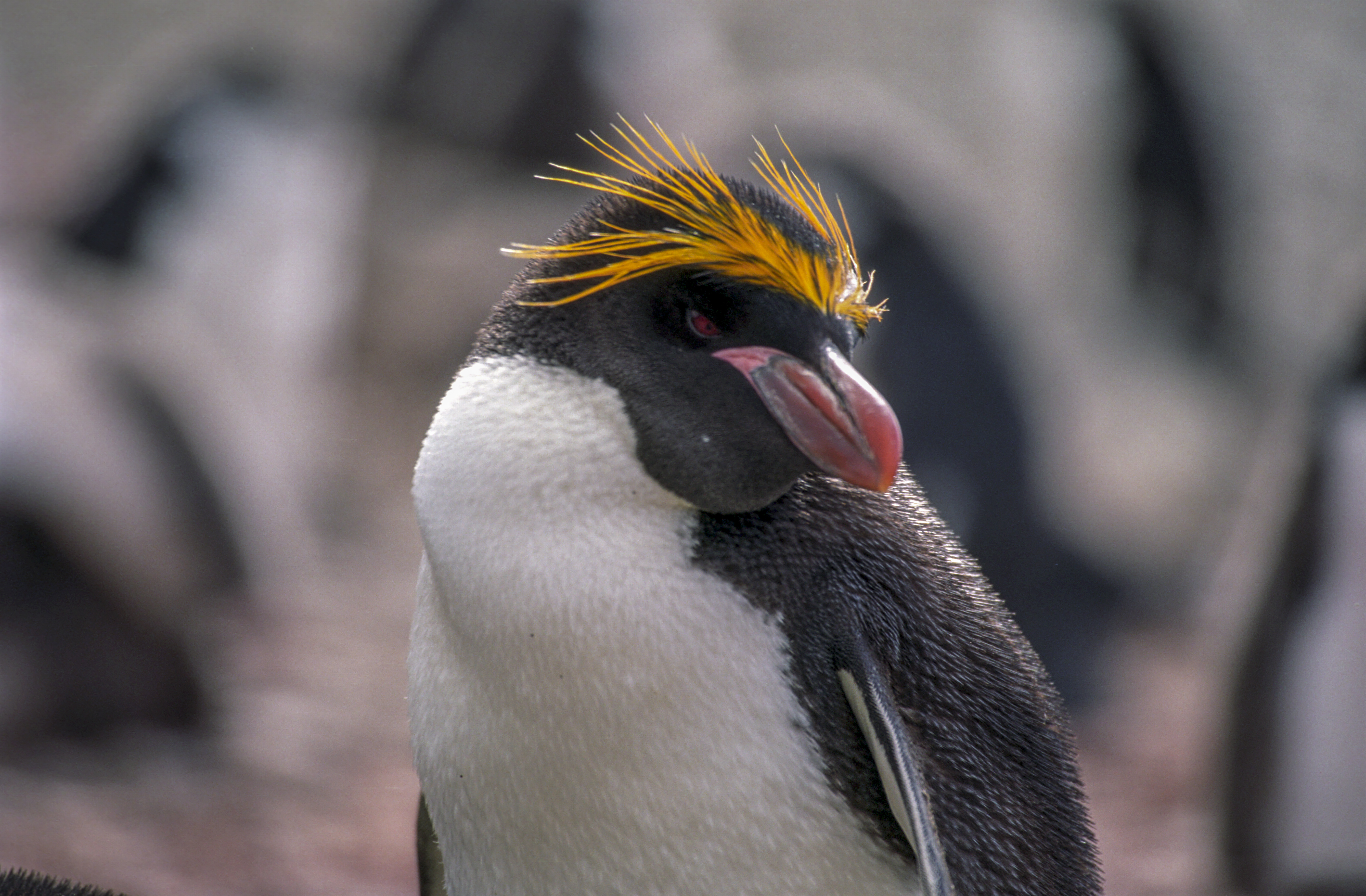
Half Moon Island was still covered in a decent amount of snow, but it was bustling with penguin activity. In our hour and a half there, we saw four species of penguins! We saw the two that we have seen throughout the trip first. The island is primarily a Chinstrap colony, so there were hundreds of them all over the place. Right where we landed, we also saw a couple of Gentoos, which we have seen throughout the Antarctica peninsula. That said, up at the top of one of the chinstrap colonies we saw a single Macaroni penguin, which was quite stunning. Macaroni penguins are the ones with the bright yellow/orange feathers that look like flamboyant eyelash extensions, and overall are much more colorful than the chinstraps and other penguins. After a good 20 minutes of getting pictures of the Macaroni surrounded by the chinstraps, we walked down the mountain back towards the water, where we saw an Adelie penguin too! The Adelie penguin is identifiable by its all-black head, whereas most (all?) other penguins have some type of either white and/or other color in their heads. I found it quite remarkable that in one tiny little island we saw four species of penguins. Then, just for kicks, we saw an elephant seal, which we had only first seen earlier today at Hannah Point, swimming by in the water.

At 8:35pm, I stepped into the zodiac, and left the land of the white continent. You know, it is interesting. Before coming on this trip, I very much was of the belief that I would save up and make it happen, and then probably leave it alone. Maybe I would get back someday, maybe not, and if not, that would be perfectly fine. After coming, however, I can now tell you with near certainty that I will be back to continue exploring. Maybe a different trip, different ship, different season, and different places, but the continent is one of those natural wonders that is simply awe-inspiring. I have always said it is hard to sit at the rim of the Grand Canyon and come to the mental grasp that what you are seeing in front of you is actually real. Antarctica is much the same thing. It feels like it is on another planet, and in almost all respects, it is unlike anything else we have on this one. Having now been to all seven continents, it is extremely clear that this one is the most unique, and most otherworldly. At some point, I will be back.

Sunday, January 8, 2012

Neko Harbor

December 18, 2011

PARADISE BAY, ANTARCTICA -- Both landings today were on the continent itself! As such, all doubt possible is gone, although we have been on the continental shelf for every landing we have done anyway.

We had another good day of weather – no winds and no precipitation. At our first landing, at Neko Harbor, we saw Gentoo penguins as we climbed halfway up a mountain, and they demonstrated as previously stated how they can scale an icy mountain at a far faster rate than we humans can. That said, we had nearly three hours for this landing – most are around 1 hour, maybe a little more, but this was about double our next-longest landing thus far, and it was nice to have a really leisurely pace.

Later on, we had a short zodiac cruise where we saw some crazy ice reflections in Neko Harbor. The winds slowed to still, and most of the zodiacs went in a different direction, so everything was virtually flat. The pictures of the icebergs and the snow-capped mountains reflecting off the still water turned out great. An interesting observation by one of our zodiac drivers with regards to why humans are so infatuated with penguins suggested that it is because of all the other animals out there, they are the only ones that stand upright and walk on two legs, as we do. As someone who is infatuated with penguins, I had never thought of that, but it certainly makes a lot of sense.

Early this afternoon after lunch we saw an enormous tabular iceberg at Andvord Bay – it was far taller and far wider than our ship, which is pretty much the definition for an enormous as opposed to a large iceberg. I decided to create a little project, as we had some warning before reaching it. I ended up taking a 145-picture time-lapse of our ship turning around the iceberg. I took the shots in five-second intervals over nearly 10 minutes in total, on a gorillapod attached to the ship railing, and then timed out the shots and turned into a time-lapse video. The video turned out pretty good and they later showed it to everyone at our daily recap/briefing.

This afternoon we saw an Argentinean base, Almirante Brown Station at Paradise Bay. Interestingly nobody was there – the station is kept mainly to keep up the Argentinean sovereignty claim to this part of Antarctica. Apparently they come once in awhile for a few days or weeks at a time, and it is totally hit or miss. That said, it was a very nice and picturesque area. We climbed to the top of a mountain on the base, and at the top saw an amazing 360-degree view of the Paradise Bay channel. The hike was very steep, so on the way down after slipping on the ice a few times, we “bum-slid” our way halfway down the mountain until the path steadied out a bit, then hiked our way back to shore. From the station, we did a zodiac cruise over Paradise Bay, where we saw a Weddell Seal and a Crabeater Seal. Most spectacularly, we saw ice calving at Paradise Bay, with a thunderous roar. The first time I heard it, I wasn’t entirely sure what it was, and then saw the last little bits of ice chunks falling into the water, where a massive ripple wave and effect was already underway. Sure enough, we saw this happen a couple more times at Paradise Bay – for whatever reason, either the weather was right, we had good timing, or some combination of the two!

Back on the ship, we had a Filipino dinner tonight in honor of our mainly Filipino staff, also the “crew band” played in the Polar Bear Bar. The crew band ended up being pretty darn good – I was left impressed. The singer, Garnett, is also one of our two bartenders, so we know him better than almost anybody else, and his mannerisms singing were priceless. Later on, after the band finished and most of the people left (it was packed while they were playing), we started to break out dancing, which was a ton of fun. At one point Garnett got out from behind the bar and started doing the Soulja Boy dance with us – quite a sight I am sure. Thanks to all dancers and dance partners, but especially to Mary Grace, who absolutely kicked my ass out there. It is always fun dancing with a better partner than you are – she taught me a few moves!

Quote of the day comes from Amundsen, who if you have been following along or at the very least know your history, was the first man to make it to the South Pole: “An adventure is an expedition not planned correctly.”

Orne Harbor

December 17, 2011

ORNE HARBOR, ANTARCTICA -- Hello, sunshine!!! For the first time since we were still in the Drake Passage, we got some really nice sunshine and weather all around. The wind wasn’t too terrible, nor were the waves, and the sun felt great. Almost more importantly, the sun granted us some good light for pictures, so all those gentoo penguin close-ups should turn out now. J

Our first stop was at Danko Island, where we climbed up a mountain, over 500 feet over the bay. The hiking trail went around a number of gentoo penguin colonies, with some very well-defined penguin highways. I ended up getting stuck in the snow on the way down – it had just fallen the previous few days, and therefore it was really tough walking and hiking conditions, but it was a lot of fun!

It was interesting watching the penguins – despite their appearance, they walked straight up this mountain way faster than we could, at probably 3-4 times our speed. You see penguins waddling around and walking quite slowly most of the time, but put a penguin on a penguin highway heading straight up a 500+ foot mountain, and they absolutely whoop our butts.

I fell over a number of times hiking, but the snow was refreshing in the sunshine and wind! Sometimes with all the gear on it becomes really easy to over-heat, so you need to slow down for numerous reasons – you don’t want to break a sweat and then be out in Antarctica with a cold body for several hours. As such, the quickest way to cool down is usually to just pull off to the side of a hiking path and throw yourself into the snow, laying there for awhile.

After our landing on Danko Island, we did an iceberg zodiac cruise right around the island. We saw a Wedell seal as well as a Crabeater seal. We also saw a number of ice arches and ice bridges that were rather unique. We asked our zodiac driver, Matt, if we could drive under one, and the response was that despite their innocent appearance, they weigh hundreds if not thousands of pounds and could kill you instantly. We wisely took in the view from afar (not really afar, per se, but from 15 feet away instead of directly under it).

In the afternoon we cruised over to Orne Harbor, where we saw an iceberg with four Crabeater seals all sharing it. By this point in the blog, you’ve read a number of times about Crabeater seals. No, they do not get boring in the least bit – quite the contrary, you start to analyze them and look for traits, such as scars on the back (finding one without any is extremely rare), scars on the face (mostly fighting amongst males), and other characteristics. It is fun but also educational, and our ability to noticeably identify these animals as well as birds and others is a testament to the staff here and their lectures that have been top-notch. Thanks staff!

In addition to the four seals, we saw a colony of chinstrap penguins. Interestingly, there was one gentoo there amongst them as well, which isn’t extremely rare, but you really notice the differences between them when they are standing next to one another and one is twice the size while the others are more nimble and adaptable, etc. The colony of chinstraps was on the steepest mountain and rocks we have seen so far, virtually a cliff, and I gained a newfound respect for them in watching them attempt and succeed at scaling them.

Tonight was camping night, so for those lucky enough to have booked it (camping was sold out by the time I knew about it), they departed immediately after dinner. As such, for the group still on board, we were determined to have a memorable evening. We ended up in the Discovery Lounge quite late. At one point I was out on the deck behind the Polar Bear Bar, and saw an iceberg come flying by us as we were anchored. I decided to put the camera and tripod to action – I set it up on the ship railing, and shot a 10 minute HD video, that I later sped up to eight times speed. At that rate, you can really see the iceberg moving, our ship spinning on anchor, the zodiacs bringing out the campers zipping by, and even the penguins coming by into and out of the frame, swimming along.

During all of this, I was outside wearing my white workout shorts and a long sleeve black workout shirt. Why? No, I was not running (although that always sounds good). Instead, tonight was Black and White dinner night, so everyone was dressed up in black and white, and that was all I had. After dinner, however, we voted on the best costume, and the winners won some champagne. From there, we played a fun game of guessing Antarctica vocabulary – three staff members would go up and tell a story explaining the meaning of a word (lurker and doomix, to name a few examples), only one was true, and we had to guess. Our group did terribly – out of eight words, we got all of two correct, but the staff members were great and it was a lot of fun.

Quote of the day, courtesy ship historian Scott, comes from Barry Lopez, and I think does an excellent job of capturing the majesty of this place: “Antarctica reflects the mystery called G-d.”

Southernmost Point

December 16, 2011

LEMAIRE CHANNEL, ANTARCTICA -- Good evening again from Antarctica’s version of an “Inside Passage,” this time specifically at the Lemaire Channel, only about 15-20 miles south of where I wrote from last night, the Neumayer Channel. The reason for this is we began our day by reaching our “furthest south” point, which we officially clocked at 65 degrees, 08.478 minutes south (and 064 degrees, 03.839 minutes west, in case you were curious), accomplished at 9:40am. We were actually intending on heading further south than that, to Petermann Island, but unfortunately about midway through the channel, we encountered heavy ice. We actually tore a good mile or so into the ice, but it got to a point beyond our ability, and given the slow pace, we decided to turn around from there.

While drying off, we had a lecture from Alex, the ship’s geologist, on the subject of ice and icebergs. We covered the coreolis effect, which I first learned about back in AP Environmental Science in High School – thanks Mr. Carlson! The effect basically explains global weather patterns, which come into play down here in Antarctica as well. Since the planet obviously rotates, and the equator is the hottest part of the planet, there is a distinct pattern whereby weather heads in a specific direction and a specific angle, creating points of emphasis at the poles, 30 degrees, 60 degrees, and the equator. This partially explains the Antarctic convergence occurring right at around 60 degrees south. It also explains why the Southern Ocean circulates in a clockwise, west-to-east direction. This is a large part of what makes the Drake Passage so powerful – these unchanging, uninterrupted currents that circle the continent endlessly allow the swells to grow quite powerful, and are what makes the Drake the roughest crossing in the world, and also making the Antarctic convergence the largest biological barrier on earth.

This same effect is what keeps Antarctica so cold – virtually no heat is able to reach the continent, thus keeping it rather covered in permanent ice, which was the actual subject of the lecture. Ice covers over 99 percent of Antarctica, and it is essentially the historical data bank for climate science on our planet. Just recently, scientists were able to drill ice cores giving air samples going back 800,000 years, an increase from the 650,000 year record I previously knew about. Apparently there are ice cores that are known to go back to 1 million years, but getting the confidence interval on their accuracy has been too challenging thus far.

In Antarctica there are basically two types of ice – sea ice and glacial ice. The sea ice freezes on an annual basis, in the winter, and then melts off during the summer. Much of the floating ice around is sea ice. Occasionally, however, we have seen amazingly blue ice, that is actually glacial ice. The glaciers flow out to several ice shelves, such as the Ross Ice Shelf, Ronne Ice Shelf, Amery Ice Shelf, and closest to us, the Larsen Ice Shelf. From there, they eventually break off into the ocean, where they form the majestic blue floating icebergs.

Last note from the lecture – while there is an alarming amount of ice melting in West Antarctica, including the peninsula where we are now, the ice is actually growing in East Antarctica. Regardless, if enough ice melts in West Antarctica, the global impact would be tragically irreversible, which helps to explain the importance of working to combat global warming. If all the ice melted in Antarctica, global sea levels would rise by about 800 feet. Not very likely, but indicative of just how enormous the impact can be.

With our Petermann Island landing impossible, we altered course and set off for Booth Island, somewhere the M/S Expedition had never been before, which is always exciting as an event, bringing a ship into a new place. We had an hour ashore in a driving snow and occasional hail, where we saw a large number of gentoo penguins, blue-eyed shags, as well as the landing site of the most important explorer of the Antarctic Peninsula, Jean-Baptiste Charcot, a Frenchman who was conducting 28 volumes of scientific evidence around 1909.

Despite the fact that we were all thoroughly soaking wet from the precipitation, the wind had died down, and we decided to do a zodiac cruise through the Iceberg Graveyard, an area where glacial icebergs notoriously run aground and thus leave them susceptible to close-proximity exploring. Usually we stay at least as far away from the icebergs as they are tall, in case one flips over (which apparently happens somewhat frequently). When they run aground, however, we can get as close as we want, since that danger is muted. The cruise was phenomenal – it actually stopped snowing, the wind died down, and while very cloudy, the weather was the best we have had in three days down here!

The glaciers were phenomenal – I got a great shot of one reflecting off of still water, and another off of Alison’s (a fellow passenger and Brit on the ship with us) ski goggles reflecting to myself with the ice behind me. I also recorded a lot of video – the still waters made for great moving videos from the zodiacs without fear of water splashing onto the camera. Then, just as we got to our hour and thus time to return to the ship, we got a call over the radio that one of the other zodiacs spotted an orca! We raced off to the sighting, where we saw two beautiful male orcas traversing the bay, surfacing every couple of minutes. Later we found out that one of them actually swam under a zodiac. Perfect ending to another great day in Antarctica!

Thursday, December 29, 2011

Port Lockroy - Passport = Stamped!


December 15, 2011

NEUMAYER CHANNEL, ANTARCTICA -- Good evening from the coast off the Antarctic Peninsula! We cruised overnight across the Bransfield Strait southeast to the peninsula, and this morning arrived at Paradise Bay.

This morning we awoke to a change in weather. For the first time since leaving Buenos Aires, we had a big calming of the wind, and virtually flat seas. In exchange for those bits of good news, the temperature dropped from the upper 30s/low 40s to the low 30s, below freezing, and the skies decided to drop some snow on us, making the decks rather slippery, and our day of landings and cruising was quite eventful.

First up, in Paradise Bay, was a zodiac cruise. Instead of making an actual landing, we simply had an hour to cruise amongst ice cliffs and icebergs in the snow, which was a ton of fun, although shooting pictures was quite a challenge in a pretty heavy and wet snow. That said, I did get a few good ones, and the hour was busy. First up, we saw a full ten crabeater seals come within ten feet of our zodiac! They must have heard us coming and decided to be playful, and surfaced right in front of us. By the time everyone had our wet cameras ready, they were further ahead, although I did get some good pictures of them playing right in front of the zodiac we were traveling with us, just up ahead. After seeing the seals, we next saw a small flock of gentoo penguins, and then a couple of snow petrels. Snow petrels are birds that are actually native to Antarctica. They are born, live, and breed here without leaving, which make them incredibly unique. Most penguins, whales, seals, and other animals all leave and then spend some significant time here, but are not really native to Antarctica. The snow petrel, however, is just that, and seeing them flying in the snow and white ice was majestic.

The highlight of the zodiac cruise was stepping onto a floating iceberg in the middle of the strait. We found a larger piece of deep ice with a flat ending so that we were able to actually land the front of the zodiac on top of it, and then got off the bow of the zodiac onto the iceberg. We had a small makeshift snowball fight, took some pictures, and I got a nice video of everyone surrounded by the water on a single piece of ice, as we floated along. Kind of scary in hindsight but a great experience nonetheless!

After the zodiac cruise we had some lunch and set sail over to a British research station at the peninsula, Port Lockroy. We had a short briefing from workers from the base, and then got our passports stamped with an actual Antarctica stamp! Another milestone – getting my seventh continent passport stamp, and all seven continent stamps in a single passport, another one of those special things people deliberately set out to achieve, and that I didn’t realize was even possible until quite recently. The stamp is great and came out nice and sharp – see photo below!

We had two landings at Port Lockroy - the UK base itself and then a separate penguin colony across from it. First stop was the penguin colony, where we saw a huge number (several hundred?) gentoo penguins, and a beautiful and unique bird, the blue-eyed shag. I find it rather hilarious that a bird native to a British base in Antarctica was named a shag, yet not at all surprising, haha. At the base itself, there was a post office where I was able to send out a couple of postcards. The route they take is nuts – the mail goes from Port Lockroy to the Falkland Islands, and then from there on a military flight back to the UK, and then from the UK onto the US or anywhere else in the world you want to send mail to. Certainly not the most direct route, and I am quite curious when they will arrive!

Also at Port Lockroy was a souvenir shop – I got myself a hat, a t-shirt, and a small stuffed penguin animal for home. There was also a population of penguins at the base itself that is used to humans, and I got an excellent video of a penguin walking right up to and then next to me, and past me. You can see exactly what the penguin was thinking as it approached and then passed me – it is quite funny to watch.

The workers at the base work there for five months at a time, which is impressive enough as it is, but then on top of that, they aren’t allowed to have a boat per the Antarctic treaty, so they are effectively stuck on a tiny little island endlessly. We are letting the four girls who work there shower on our ship and have a good dinner with us tonight. Dinner ended up being Indian food, which, like everything else on this ship, was quite tasty. Another night at the polar bear right now blogging, checking photos, and enjoying each other’s company. Quote of the day belongs to me, referring to Antarctica as we took photos of all who had reached Antarctica as our seventh continent: “Antarctica, number seven on our lists, number one in our hearts.” Looking forward to what tomorrow brings in the white continent!

Seven Continents, Five Oceans, One Day

December 14, 2011

DECEPTION ISLAND, ANTARCTICA -- Today we finally did it! Nearly a week of travel later, we landed on Antarctica itself!

Our first landing site was at Aitcho Island, one of the South Shetlands. The weather was dry but very, very windy, and as such our first zodiac ride was rather eventful with good sized waves and plenty of splash too. We saw two penguin colonies on Aitcho Island – Gentoo penguins and Chinstrap penguins. Interestingly we saw that some of the Gentoo penguins were breeding within the Chinstrap colonies, and vice versa. Most of the penguins in the opposite colonies were rather chastised, however, and were routinely beaked or “barked” at. We also set up the mandatory “seven” for getting to the seventh continent!

Our first landing in Antarctica was coincidentally on the centennial of Amundsen reaching the South Pole, also on December 14th, back in 1911. Pretty amazing to have made it myself to all seven continents at such a young age – I really don’t even know what to make of it all. Maybe it will come to me with time, but right now I am just enjoying being here, getting some great photographs, sharing these experiences with some new but great friends, and trying to journal as much as possible to give some meaning to the thousands of photos. All seven continents… I am one lucky guy to have been able to make this happen.

In any case, Aitcho Island was a fun landing – we spent a full hour on the island between the two penguin colonies, and I got to see them nesting, feeding, and collecting pebbles and rocks to build their nests, all while simultaneously fending off predatory birds who were constantly looking down at them trying to pick off an egg or two.

From there we had a five hour cruise to our next destination, and just after getting started, we were out on the deck and saw two humpback whales slapping their fins against the ocean, turning in circles and being incredibly playful. Susan, who was on the intercom announcing their arrival, had the quote of the day, said moments after they started playfully slapping the water: “Ladies and gentlemen, it is officially a criminal offense if you do not come out on the deck right now to take a look at this.” She was correct – it was incredible.

Throughout the rest of the cruise over we dried off, looked over photos, had some lunch, and then got ready for Deception Island, one of the places I had actually heard about in Antarctica prior to knowing anybody who had been here. Deception Island is an active volcano, with a huge bay in the middle. It is actually somewhat similar to Crater Lake National Park in Oregon, except instead of being inland and a complete circle, Deception is an Island in the South Shetlands of Antarctica, and has a very narrow entrance blown out, thus allowing ships to enter and exit. That entrance and exit is named Neptune’s Bellows, and there have been several shipwrecks heading through them.

Our first landing on the inside of Deception Island was at Telefon Bay, a black sand beach, where we saw a blonde Weddell seal sleeping on the beach. The seal was adorable – it was clearly dreaming or thinking of something, and kept salivating and showing its teeth as it laid otherwise motionless and sleeping.

That said, our landing there was actually to go for a climb – we climbed up to the summit of a newly formed edge of the volcano. The climb was actually quite high – I wasn’t able to measure it, but we were a good 500 feet up, which in Antarctic gear and with the wind and temperature as they were, was rather impressive. From the top we could see clear over the boat and the bay and it made for a great video panorama of the whole island, including one of the two research stations there being visible. One was there to monitor aquatic life, and the other to monitor seismic activity, given that it is an active volcano and all.

After the first landing at Deception, we traveled about a mile across the bay to another beach, where around half of our ship cruised over to the beach via zodiac, and we collectively got undressed to our swimsuits and jumped into the ocean. No, not any hot springs, or anything remotely warm, but 32F/0C degree frigid polar Antarctic/Southern Ocean water! I got my tripod set up and recorded myself and a bunch of others jumping in! Jay, another fellow American on-board, got two phenomenal videos of me jumping in – I need to get copies of them.

With that polar plunge complete, I have successfully swum in all five oceans! The Atlantic, Pacific, Indian, Arctic, and now the Southern/Antarctic Ocean.

In one day, I managed to land on my final continent AND swim in my final ocean. How do you even try to top this? Another day, another incredible series of events that I will remember about forever.

Friday, December 23, 2011

We Made It!

December 13, 2011

SOUTH SHETLAND ISLANDS, ANTARCTICA -- Well, we had quite a night last night! We ended up staying awake through the night. Sunrise moved up from 4:15am to 3:47am, a pretty significant difference! We decided around 1am that since we were awake anyway, and past 59 degrees south, we would stay up until we got to 60 degrees. The reason this is significant is that 60 degrees south is the politically defined boundary for Antarctica, as covered under the Antarctic treaty. Once you hit 60 degrees, you are politically in Antarctica, and thus the excitement! As it turned out, we stayed up until 4:13am, after sunrise, when we hit the boundary and technically made it to Antarctica!

The second boundary for making it to Antarctica is the Antarctic Convergence, the largest biological barrier in the entire world. The exact boundary is always changing, but when it is hit, the sea temperature drops from around 37-40F to 30-32F, and 99.9% of sea life disappears accordingly. Anything that can survive south of the convergence inhabits the Southern Ocean – this is where the Atlantic and Pacific end, and the Southern Ocean begins. Residents of the Southern Oceans are Antarctic by nature, or at least can survive it for certain periods of time. As it turned out, we crossed the convergence around 9pm yesterday, so before hitting 60 degrees south for the political boundary. Biologically we had made it to Antarctica!

After a few hours of sleep we had a few more lectures following breakfast. We learned about marine animals in and around Antarctica, with one on dolphins and whales, another on seals and fur seals, and a last one on penguins, of course! We also had a mandatory IAATO briefing – the International Association of Antarctica Tour Operators, which guides how all tour operators, including G Adventures, must operate while in Antarctica. It sets out all kinds of rules for landings – no two ships can ever land at the same place (which means we haven’t seen any other people since we were in Argentina), we have to stay a certain distance from all animals (5 meters from penguins and most other birds, 15 from seals and fur seals, 30+ from animals displaying certain behaviors of aggression), and other various rules such as not leaving anything on shore. As such, we aren’t to bring tissues on shore; tripods must be disinfected prior to bringing them (since they will actually touch the ground), etc. Also, no more than 100 people can ever land at a single time – since our ship is more than that, we were broken into two groups to alternate landing times. Group 1 goes for an hour, then Group 2 (my group), then the order is reversed for the next landing and beyond. The briefing and the strength of the rules followed were rather pleasing – it shows an attempt at minimal impact while still providing for what is sure to be an incredible experience.

After all the lectures and briefings, and more time on deck and on the bridge noticing how the water got darker and the air colder, we got past 61 degrees south, and it was clear we were nearing the continent itself!

The third definition for Antarctica is, of course, land, and at around 5pm, several hours ahead of schedule, we first spotted Nelson Island, one of the South Shetland Islands, some 60 miles off the coast across the Bransfield Strait from the Antarctica continent mainland itself. For the first time in two days, the waters calmed, and we were able to see land, mostly covered in ice and snow. As the land came into view, very shortly thereafter we noticed a large number of penguins welcoming our ship into the Nelson Strait! Our first penguin viewing was so exciting! It is the type of thing that just gets your heart racing and leaves you with a very wide grin. I will never forget the look on Kathryn’s face, she was most excited of all, at least visibly! Seeing dozens of penguins swimming and jumping into the air in motion leading our ship, and looking out at both Antarctica for the first time, and the massive ocean – it was something that cannot really be described appropriately. Suffice it to say that it was the highlight of the trip to that point. Then, just as the penguins started to taper off, we looked off to the port (left) side and we saw a humpback whale surfacing! The humpback was quite a ways off from us, but it was absolutely massive. I remember thinking to myself that for all the times I have been to aquariums and zoos all around the world, seeing these animals truly in the wild was just surreal. A humpback whale, penguin colony, and the South Shetlands all within an hour? Speechless.

A couple hours later, after we found a lee (a lee is a term meant for protection on the leeward side of an island, in order to protect us from the wind and the waves), we went up to the bridge to look out and saw another two humpback whales, and this time they showed us their fins and their tail – again, so exciting to see this in the middle of the ocean, out in the wild! After spending six hours yesterday on deck looking out and seeing a whale for three seconds, it was wonderful to see all these penguins and three humpbacks over the course of a few hours, nevermind calmer waters, land, and the sense of arrival.

At night it turns out we won some champagne for that first whale sighting though! Howard won a bottle for spotting the first whale seen on the ship, which he generously gave to me, and Anthony, who was with us to spot it, won a bottle for guessing the closest time for spotting it (there were contests for us to post when we thought we’d see the first whale, iceberg, and cross the convergence). We shared it with everyone and had another great evening at the polar bear bar, watching the sunset at 10:57pm – what a day!!!